April 26th, 2006
Went over to Reston to attend the Digital City Expo. Vint Cerf was the keynote speaker :)
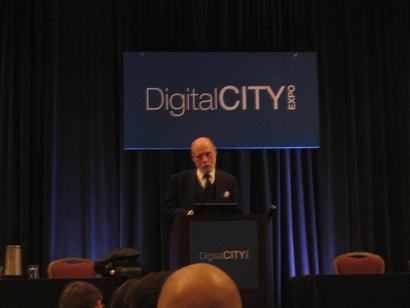
I am surprised to see so many city government officials, mostly for their fact finding trip to deploy their own muni-wireless. The driver for deploying the muni-wireless however is very different compared to metro-wireless or those deployed in Asia. Metro is mostly serving the mobile professionals (who already have internet access at home) while they are in the city while those in Asia are for alternative access and somewhat political. Muni-wireless however has a different set of drivers: getting broadband to the community to preserve jobs, increase revenue (partial due to lose of tax revenue due to VoIP), no ISPs or poor/expensive Internet access, community needs etc. Most of these cities also migrate their existing AMR onto the wireless network (e.g. equip’ing police cars with laptops). And best of all, the return on investments are very appealing.
The obvious questions on whether city governments should compete with private companies in providing Internet services. And quoting Vint Cerf, “It is not penal”. :-)
April 25th, 2006
Joining the echo chamber (altho a bit late), Viral Marketing Contest to Save The Internet by Jeff Pulver.
Ok, I am officially putting my money where my mouth is. I am initiating a viral video/ad contest to save the Internet.
I am fed up with the current wave of soundbites, platitudes, ads and marketing flooding the airwaves that profess to speak for the advancement of the Internet and communications. These ads are influencing Congress and governments around the World as they write the rules that will shape the future of the Internet and communications.
Also check out Save The Internet.
February 28th, 2006
I spend most of the day at the APIA ISOC-AU Joint Forum. Seem like the whole gang of the typical IETF suspects (IAB & IESG) are here among other speakers.
The speech of the day has to come from Chris Disspain from auDA at the last session. His description of the prepcomm3 of the WSIS process can be summarized by one comment he made (I am writing from memory): “One government official said: It is great that WSIS is a open transparent multi stakeholder process but never forget the government is in charge”.
This is pretty much consistent from what I gathered from other folks over the last few days: WSIS Tunsia is quite a disaster. Other stories includes countries asking for basic stuff like “I need power station in my country” and some outright asking for money. The sense I got was many are glad that WSIS is finally over although IGF is still around.
Now, this is not to say I have no sympathy for those who ask for money or basic infrastructure like power but obviously it is the wrong forum. More importantly, I am extremely scared these folks has an equal (and often veto) voice in the process.
Not all of WSIS is bad: At least a lot of countries has an understanding what Internet is about and how it is coordination function after 5 years of activities.
Personally, I believe something like WSIS is a good thing. Network is global and there are many things governments could and should work together, like cybercrime, spams, phishing etc etc. Unfortunately, WSIS tries to do too much in too little time without enough clue. Perhaps it is not meant to be for now.
Reminder to self: As I was trying to find some clueful folks to help me to solve a routing problem in SingAREN GIX, one said: “Is this related to TEIN2? TEIN2 routing is one of the most complex network, far more then any commercial networks I know.” Coming from Randy Bush, that say alot. I probably should pay more attention to the routing group in TEIN2.
February 27th, 2006
One of the problem of not attending meetings for a while is you start to forget someone name. Okay, at least I have that problem. So many times that someone come forward to say hi and I have to struggle to remember their name, esp. I cant see their name tag.
For those whose name I forgot, I am sorry. I have a good memory for faces but very bad with names. Its nothing personal.
Anyway, I dont really remember much what happened today. I was in a series of meetings, then running around finding people to talk to on a project I am working and poof dinner time. Oh yea, I had dinner. Twice. Once with Prof. Qian, Mao Wei and Wu Guowei and then another hosted by PIKOM chairman.
Between the geek talks, the usual WSIS/ICANN stories (gosh, the Tunsia hotel story was funny :-), one particular incident left a strong impression on me. One of my friend has a Thai wife who also attended the latter dinner. It is obvious she is anti-Singapore anti-Thaksin (at least at this moment). My friend, her husband, said this to me: “To her, Temasek is the like the invader of Thailand”.
To a country who is very proud that they never being conquered in the last century, not even World War II, and the only southeast asia that never colonized by Western power, that say a lot. I guess that’s why there is 200,000 people turn up for a protest right now.
On a lighter side, she also mentioned she holds a PPS card and that they fly in here on SingaporeAir. She wasn’t too happy when I told her SingaporeAir is owned by Temasek :-)
February 8th, 2006
In Jan this year, a frontpage article on WSJ quoted Verizon Chief Executive Ivan Seidenberg “We have to make sure they (Google) don’t sit on our network and chew up our capacityâ€. Both AT&T and Bellsouth also made similar statements in the same article. A few days ago, Verizon repeat their call to “End Google’s Free Lunchâ€: “A Verizon Communications Inc. executive yesterday accused Google Inc. of freeloading for gaining access to people’s homes using a network of lines and cables the phone company spent billions of dollars to build.â€
Also related, Verizon filed with FCC that they have plans to set aside bandwidth on their fiber optical network, effectively creating a two-tier Internet, one big-fat pipe for Verizon and their partners services and another for the rest. This is one of the consequences many already foresee when FCC removed the many obligations from broadband providers in order to spur the growth of broadband and fiber network in 2003.
Thus, it is no surprise that Network Neutrality, a concept where broadband providers are not to discriminate rivals when they charge tolls or prioritize traffic, is now on the agenda of the US Congress.
Read the rest of this entry »
January 24th, 2006
The GENI (Global Environment for Network Investigators) Project recently released their conceptual document. GENI is a 367M USD, 5 year project supported by NSF to build the “next generation Internet”.
The document pointed out several good points about the limitation of the current Internet:
• The Internet is not secure. We hear daily about worms, viruses, and denial of service attacks, and we have reason to worry about massive collapse, due either to natural errors ormalicious attacks. Problems with “phishing†have prevented institutions such as banks fromusing email to communicate with their customers. Trust in the Internet is eroding.
• The current Internet cannot deliver to society the potential of emerging technologies such as wireless communications. Even as all of our computers become connected to the Internet,we see the next wave of computing devices (sensors and controllers) rejecting the Internet in favor of isolated “sensor networksâ€.
• The Internet does not provide adequate levels of availability. The design should be able to deliver a more available service than the telephone system. In particular, it should meet theneeds of society in times of crisis by giving priority to critical communications.
• The design of the current Internet actually creates barriers to economic investment andenhancement by the private sector. For example, barriers to cooperation among InternetService Providers have limited the creation and delivery of new services. A large number of specific problems with the Internet today have their roots in an economic disincentive,rather than a technical lack.
• The Internet was not designed to make it easy to set up, to identify failures and problems, orto manage. This limitation applies both to large network operators and the consumer athome. Difficulties with installation and debugging of the Internet in the home have turned many users away, limiting the future penetration of the Internet into society.
January 8th, 2006
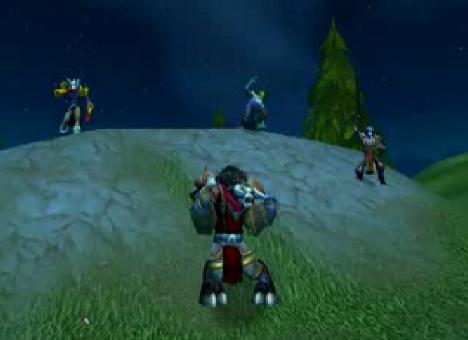
The Internet is for Porn from the Broadway Show Avenue Q, World of Warcraft edition.
December 20th, 2005
Got this article from Dewayne Hendricks:
At the same time, the Internet’s shortcomings have resulted in plunging security and a decreased ability to accommodate new technologies. “We are at an inflection point, a revolution point,” Clark now argues. And he delivers a strikingly pessimistic assessment of where the Internet will end up without dramatic intervention. “We might just be at the point where the utility of the Internet stalls — and perhaps turns downward.”
Reminded me of what I said in my previous entry altho Clark is much more explicit and direct in claiming “The Internet is Borken”. It is not new…I heard it couple of times from various people, but mostly in whispers along the corridors.
But before you write this off as a yet another crackpot, remember Clark is one of the inventors of the Internet. And I also remember Dave Farber saying something similar during one of our dinner few months ago.
Think about it.
November 24th, 2005
I just come back from the MoU signing ceremony between JGN II and SingAREN, marking a beginning of a new high-speed 155mbps R&D link between Singapore and Japan. Early last year, I paid a courtesy visit to MIC/JGN office in Japan requesting them to open their 20mbps link to the R&D community1 but I was politely turned down. However, they promised to include the R&D community if they managed to secure funding for the next phase. I am glad this little seed I planted comes to something :-)
Anyway, JGN II is project managed by NICT (which has an annual budget of 560M USD wow!). The original purpose of JGN is to provide dark fibers and L3 (IPv4 and IPv6) services connecting up the Japanese universities. Last year, they expanded their network with a OC192 (10Gbps) to StarLight (US) and a 20mbps to Singapore. Today, they expanded the 20mbps to 155mbps and also another 45mbps to Thailand.
So what are all these high-speed network used for? Well, it is basically up to our blue-sky imagination. But to start, in addition to the ongoing media industry projects, they lined up two more projects:
(1) a e-Learning project between Catholic High School and Primary/Secondary schools in Mitaka City – Students can attend virtual classes that seem as if they are attending in the same classroom.
(2) e-Health project between Singapore National Eye Centre and Asahikawa Medical College Hospital – Basically using 3D HDTV technology to allow eye patients to be examine and even operated remotely.
If you got any more ideas, I would love to hear them!
1 Credit should also go to Konishi-sensei who has been urging me to talk to MIC.
October 19th, 2005
A month ago, I mentioned about a paper by Tony Hain regarding IPv4 allocation status. The paper was recently published in the Internet Protocol Journal which sparked a debate on Slashdot. Particularly, Tony’s paper suggested that IANA will run out of IP addresses in 5 years or less.
However, there is another paper written by Geoff Hutson which predicts that we have enough IPv4 address until 2022. The differences got most people confused. So who is right?
Actually, both are right, or rather, not too far apart. Remember, Geoff Hutson’s paper looks at the complete exhaustion of IPv4 address by 2022 whereas Tony’s paper looks at exhaustion only at IANA pool. If we examine the IANA allocations, then both of them are (somewhat) consistent with Geoff’s 2013 projection and Tony’s 2010 projection. The explaination for the 3 years difference is actually in the data used for the projection: Geoff uses IANA allocations after 1995 whereas Tony’s uses those after 2000.
But whichever you believe, 2010 or 2013, it is pretty certain IANA will eventually run out of /8 to allocate to RIRs in the next X years. In fact, many are concerned that Tony’s paper will expediate the exhaustion as many ISPs (esp. the larger ones) have not asked for allocation for quite sometime, because they have overprovisioned during the dotcom days. They might not need it for the next one or two yeaers, later but with the alarm ringing that IANA may run out of addresses to allocate, it won’t be surprising that many will start to horde IP address.
Afterall, when IPv4 address becomes harder to get, don’t be surprised to see people ebay’ing their IP address in the future.